| 即将出版的六月号开放杂志,根据北京消息来源,报导如下中共高层人事的重要动向,显示胡锦涛十八大权力交班计划遇到挫折。退休的前总书记江泽民仍然有不可忽视的影响力。
中共利益集团的全部权力和巨富都来源于改革,因此人人都要争夺改革的资源。胡温遭遇困境就变成另一方攻城夺池的机遇。中美高层对话,中方的明星不是胡温,而是主管金融的王岐山。海外媒体已经称他是「中国经济总指挥」。全球著名政治风险谘询机构欧亚集团选出的「二○○九年需要关注的世界领导人」名单中,王岐山继美国总统奥巴马之后,排在第二位。国内观察人士分析:「在世界经济面临危机的情况下,实际上负责中国经济政策的王岐山比国家主席胡锦涛和总理温家宝更为重要。」传媒眼中,王岐山如同当年的常务副总理朱鎔基,排第一副总理的李克强显然已经被忽视了。王岐山另一引起公众尤其是国际社会极为重视的安排,是担任上海世博会筹委会主席。
消息人士透露,这是根据江泽民的意见作出的安排。江不但掌管军队的实权,还掌管著对美外交,从驻美大使人选,到中美高层对话人员安排,都是江决定。推重王岐山,据悉江泽民也透过他的管道取得美国的认同,奥巴马和希拉莉不公开地认可王岐山是下届中国总理最适合的人选。
看来江泽民插手十八大的野心不亚于邓小平,不但要安排总书记,还要安排总理。客观而论,王岐山的能力和政绩也远超过李克强。胡锦涛在十八大人事上已不佔优势,他选的李克强,如果输给王岐山,将只能去当人大委员长。胡锦涛心目中的隔代接班人胡春华,因为在河北省发生糟糕透顶的毒奶粉事件,进十八大常委已经无望。
最能折腾的薄熙来,很早就想调进北京,江泽民九二年为了向薄一波报恩,就已在中央提出,遇到胡锦涛的阻止。直到九七年薄熙来才进京当了一届商务部长。十七大虽然进了政治局,但是却被胡锦涛发配重庆。他在北京已经调查好文强是回击团派的软肋。团派大员司法部长吴爱英曾经有把文强调进北京提升副部级的打算,但是受到有关高层提醒:「不能盲目用,此人有些问题。」所以薄熙来到了重庆,站稳脚跟,就佈署以文强为目标的打黑路线图,摆出文强为黑后台的六个黑势力团伙关系网。文强遭遇薄熙来,必死无疑。
但薄熙来的最大目标还是汪洋,这位想以思想解放为己任的改革先锋,被文强抹了一脸黑。据说高层议论十八大人事谈到汪洋时,有人提议:「就给他政协主席当当吧。」薄熙来则因和胡锦涛结下梁子,十八大进北京高层不容易,很可能接汪洋,再去广东折腾五年。
位置最保险的是总书记人选习近平,据说进常委他就开始选择秘书和写作班底,看好社科院法学所的某研究人员,此人不愿从政,习近平亲自训了他,此人是哭著上调习办的。
江泽民最近两省南巡,曾庆红也高调曝光,都有欢天喜地之态。最难啃的硬核桃金正日和「天安舰事件」,都由胡温去啃。江泽民连边都不沾。江泽民在江苏接待的老朋友是前来参观世博会的李光耀。据说李鹏的动作也不小,《六四日记》内部公开,把胡耀邦下台的责任都推给了赵紫阳。李鹏的儿子李小鹏弃商从政(山西副省长)明显是赚够了钱,保家族平安的政治安排,朝中不能无人做官。胡锦涛也看好李鹏的路数,二○○九年十月,胡锦涛之子胡海峰曾任总经理的威视公司爆出纳米比亚涉贪丑闻之前,已经被任命清华大学副秘书长。浙江省省委去年十二月决定建立浙江清华长三角研究院党委,任命胡海峰担任党委书记。传说胡温的儿子,财富都已经不是十亿百亿。赚够的就去当官,还没赚够的继续赚。 8964 蘇聯“六四”檔案解密:天安門死3000人
注意這一段對話:
Lukyanov reports that the real number of casualties on Tiananmen Square was 3,000.(Lukyanov:天安門的真實死亡數字是3000人)
Gorbachev: We must be realists. They, like us, have to defend themselves. Three thousands . . . So what?(戈爾巴喬夫:我們必須現實。他們和我們一樣,必須維護自己。三千。。。那又怎麽樣?)
這是“六四”屠殺三千人的最新證據。此前有三個證據指向三千人這個數字:
一、六四清晨中國紅十字會及某醫院發言人分別公布,醫院死亡人數 2600-2700;一些西方情報機構的數字更高;
二、北京大學學生自治會和北高聯派出28輛校車去幾十家醫院的調查結果,與紅十字會數字吻合;(北大籌委會副主席常勁的見證;北高聯秘書長王有才的見證)
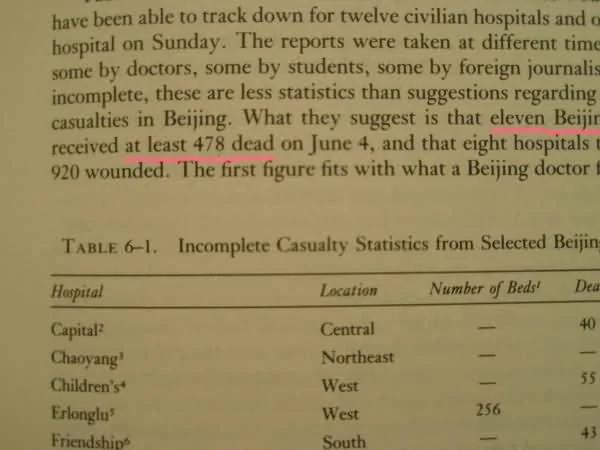
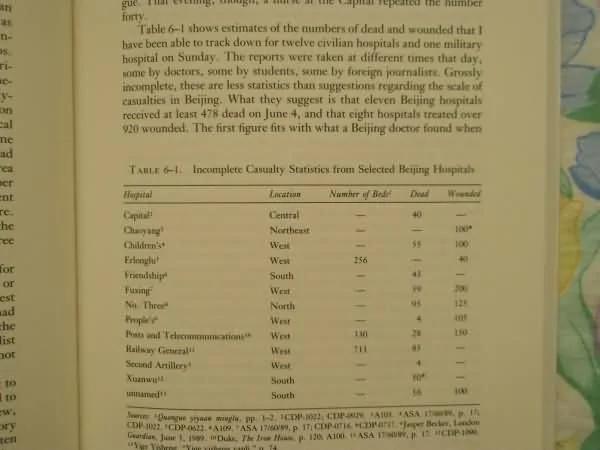
三、美國學者Timothy Brook的書中有“六四”當天11家醫院的死亡數字,總共478人;據此他推測整個北京124家醫院應有2800人死亡,與紅十字會和兩個學生組織的數字吻合。
四、這些數字僅僅是六四當天在醫院調查的,應該還有不少醫院外死亡和失蹤的情況。如戒嚴部隊沖進醫院使很多人避到醫院外,因得不到妥善治療而辭世的;另外,王楠的案例(丁子霖名單第2號)證明還有大量失蹤的情況,外界更難以知道。
Timothy Brook的書名是Quelling the People,這是該書第161頁的影像:
http://www.city-journal.org/2010/20_2_soviet-archives.html
Claire Berlinski
A Hidden History of Evil
Why doesn’t anyone care about the unread Soviet archives?
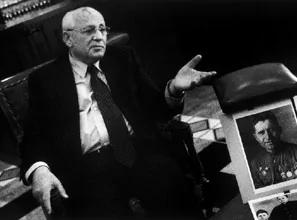
Marc Riboud/Magnum Photos Though Mikhail Gorbachev is lionized in the West, the untranslated archives suggest a much darker figure.
In the world’s collective consciousness, the word “Nazi” is synonymous with evil. It is widely understood that the Nazis’ ideology—nationalism, anti-Semitism, the autarkic ethnic state, the Führer principle—led directly to the furnaces of Auschwitz. It is not nearly as well understood that Communism led just as inexorably, everywhere on the globe where it was applied, to starvation, torture, and slave-labor camps. Nor is it widely acknowledged that Communism was responsible for the deaths of some 150 million human beings during the twentieth century. The world remains inexplicably indifferent and uncurious about the deadliest ideology in history.
For evidence of this indifference, consider the unread Soviet archives. Pavel Stroilov, a Russian exile in London, has on his computer 50,000 unpublished, untranslated, top-secret Kremlin documents, mostly dating from the close of the Cold War. He stole them in 2003 and fled Russia. Within living memory, they would have been worth millions to the CIA; they surely tell a story about Communism and its collapse that the world needs to know. Yet he can’t get anyone to house them in a reputable library, publish them, or fund their translation. In fact, he can’t get anyone to take much interest in them at all.
Then there’s Soviet dissident Vladimir Bukovsky, who once spent 12 years in the USSR’s prisons, labor camps, and psikhushkas—political psychiatric hospitals—after being convicted of copying anti-Soviet literature. He, too, possesses a massive collection of stolen and smuggled papers from the archives of the Central Committee of the Communist Party, which, as he writes, “contain the beginnings and the ends of all the tragedies of our bloodstained century.” These documents are available online at bukovsky-archives.net, but most are not translated. They are unorganized; there are no summaries; there is no search or index function. “I offer them free of charge to the most influential newspapers and journals in the world, but nobody wants to print them,” Bukovsky writes. “Editors shrug indifferently: So what? Who cares?”
The originals of most of Stroilov’s documents remain in the Kremlin archives, where, like most of the Soviet Union’s top-secret documents from the post-Stalin era, they remain classified. They include, Stroilov says, transcripts of nearly every conversation between Gorbachev and his foreign counterparts—hundreds of them, a near-complete diplomatic record of the era, available nowhere else. There are notes from the Politburo taken by Georgy Shakhnazarov, an aide of Gorbachev’s, and by Politburo member Vadim Medvedev. There is the diary of Anatoly Chernyaev—Gorbachev’s principal aide and deputy chief of the body formerly known as the Comintern—which dates from 1972 to the collapse of the regime. There are reports, dating from the 1960s, by Vadim Zagladin, deputy chief of the Central Committee’s International Department until 1987 and then Gorbachev’s advisor until 1991. Zagladin was both envoy and spy, charged with gathering secrets, spreading disinformation, and advancing Soviet influence.
When Gorbachev and his aides were ousted from the Kremlin, they took unauthorized copies of these documents with them. The documents were scanned and stored in the archives of the Gorbachev Foundation, one of the first independent think tanks in modern Russia, where a handful of friendly and vetted researchers were given limited access to them. Then, in 1999, the foundation opened a small part of the archive to independent researchers, including Stroilov. The key parts of the collection remained restricted; documents could be copied only with the written permission of the author, and Gorbachev refused to authorize any copies whatsoever. But there was a flaw in the foundation’s security, Stroilov explained to me. When things went wrong with the computers, as often they did, he was able to watch the network administrator typing the password that gave access to the foundation’s network. Slowly and secretly, Stroilov copied the archive and sent it to secure locations around the world.
When I first heard about Stroilov’s documents, I wondered if they were forgeries. But in 2006, having assessed the documents with the cooperation of prominent Soviet dissidents and Cold War spies, British judges concluded that Stroilov was credible and granted his asylum request. The Gorbachev Foundation itself has since acknowledged the documents’ authenticity.
Bukovsky’s story is similar. In 1992, President Boris Yeltsin’s government invited him to testify at the Constitutional Court of Russia in a case concerning the constitutionality of the Communist Party. The Russian State Archives granted Bukovsky access to its documents to prepare his testimony. Using a handheld scanner, he copied thousands of documents and smuggled them to the West.
The Russian state cannot sue Stroilov or Bukovsky for breach of copyright, since the material was created by the Communist Party and the Soviet Union, neither of which now exists. Had he remained in Russia, however, Stroilov believes that he could have been prosecuted for disclosure of state secrets or treason. The military historian Igor Sutyagin is now serving 15 years in a hard-labor camp for the crime of collecting newspaper clippings and other open-source materials and sending them to a British consulting firm. The danger that Stroilov and Bukovsky faced was real and grave; they both assumed, one imagines, that the world would take notice of what they had risked so much to acquire.
Stroilov claims that his documents “tell a completely new story about the end of the Cold War. The ‘commonly accepted’ version of history of that period consists of myths almost entirely. These documents are capable of ruining each of those myths.” Is this so? I couldn’t say. I don’t read Russian. Of Stroilov’s documents, I have seen only the few that have been translated into English. Certainly, they shouldn’t be taken at face value; they were, after all, written by Communists. But the possibility that Stroilov is right should surely compel keen curiosity.
For instance, the documents cast Gorbachev in a far darker light than the one in which he is generally regarded. In one document, he laughs with the Politburo about the USSR’s downing of Korean Airlines flight 007 in 1983—a crime that was not only monstrous but brought the world very near to nuclear Armageddon. These minutes from a Politburo meeting on October 4, 1989, are similarly disturbing:
Lukyanov reports that the real number of casualties on Tiananmen Square was 3,000.
Gorbachev: We must be realists. They, like us, have to defend themselves. Three thousands . . . So what?
And a transcript of Gorbachev’s conversation with Hans-Jochen Vogel, the leader of West Germany’s Social Democratic Party, shows Gorbachev defending Soviet troops’ April 9, 1989, massacre of peaceful protesters in Tbilisi.
Stroilov’s documents also contain transcripts of Gorbachev’s discussions with many Middle Eastern leaders. These suggest interesting connections between Soviet policy and contemporary trends in Russian foreign policy. Here is a fragment from a conversation reported to have taken place with Syrian president Hafez al-Assad on April 28, 1990:
H. ASSAD. To put pressure on Israel, Baghdad would need to get closer to Damascus, because Iraq has no common borders with Israel. . . .
M. S. GORBACHEV. I think so, too. . . .
H. ASSAD. Israel’s approach is different, because the Judaic religion itself states: the land of Israel spreads from Nile to Euphrates and its return is a divine predestination.
M. S. GORBACHEV. But this is racism, combined with Messianism!
H. ASSAD. This is the most dangerous form of racism.
One doesn’t need to be a fantasist to wonder whether these discussions might be relevant to our understanding of contemporary Russian policy in a region of some enduring strategic significance.
There are other ways in which the story that Stroilov’s and Bukovsky’s papers tell isn’t over. They suggest, for example, that the architects of the European integration project, as well as many of today’s senior leaders in the European Union, were far too close to the USSR for comfort. This raises important questions about the nature of contemporary Europe—questions that might be asked when Americans consider Europe as a model for social policy, or when they seek European diplomatic cooperation on key issues of national security.
According to Zagladin’s reports, for example, Kenneth Coates, who from 1989 to 1998 was a British member of the European Parliament, approached Zagladin on January 9, 1990, to discuss what amounted to a gradual merger of the European Parliament and the Supreme Soviet. Coates, says Zagladin, explained that “creating an infrastructure of cooperation between the two parliament[s] would help . . . to isolate the rightists in the European Parliament (and in Europe), those who are interested in the USSR’s collapse.” Coates served as chair of the European Parliament’s Subcommittee on Human Rights from 1992 to 1994. How did it come to pass that Europe was taking advice about human rights from a man who had apparently wished to “isolate” those interested in the USSR’s collapse and sought to extend Soviet influence in Europe?
Or consider a report on Francisco Fernández Ordóñez, who led Spain’s integration into the European Community as its foreign minister. On March 3, 1989, according to these documents, he explained to Gorbachev that “the success of perestroika means only one thing—the success of the socialist revolution in contemporary conditions. And that is exactly what the reactionaries don’t accept.” Eighteen months later, Ordóñez told Gorbachev: “I feel intellectual disgust when I have to read, for example, passages in the documents of ‘G7’ where the problems of democracy, freedom of human personality and ideology of market economy are set on the same level. As a socialist, I cannot accept such an equation.” Perhaps most shockingly, the Eastern European press has reported that Stroilov’s documents suggest that François Mitterrand was maneuvering with Gorbachev to ensure that Germany would unite as a neutral, socialist entity under a Franco-Soviet condominium.
Zagladin’s records also note that the former leader of the British Labour Party, Neil Kinnock, approached Gorbachev—unauthorized, while Kinnock was leader of the opposition—through a secret envoy to discuss the possibility of halting the United Kingdom’s Trident nuclear-missile program. The minutes of the meeting between Gorbachev and the envoy, MP Stuart Holland, read as follows:
In [Holland’s] opinion, Soviet Union should be very interested in liquidation of “Tridents” because, apart from other things, the West—meaning the US, Britain and France—would have a serious advantage over the Soviet Union after the completion of START treaty. That advantage will need to be eliminated. . . . At the same time Holland noted that, of course, we can seriously think about realisation of that idea only if the Labour comes to power. He said Thatcher . . . would never agree to any reduction of nuclear armaments.
Kinnock was vice president of the European Commission from 1999 to 2004, and his wife, Glenys, is now Britain’s minister for Europe. Gerard Batten, a member of the UK Independence Party, has noted the significance of the episode. “If the report given to Mr. Gorbachev is true, it means that Lord Kinnock approached one of Britain’s enemies in order to seek approval regarding his party’s defense policy and, had he been elected, Britain’s defense policy,” Batten said to the European Parliament in 2009. “If this report is true, then Lord Kinnock would be guilty of treason.”
Similarly, Baroness Catherine Ashton, who is now the European Union’s foreign minister, was treasurer of Britain’s Campaign for Nuclear Disarmament from 1980 to 1982. The papers offer evidence that this organization received “unidentified income” from the Soviet Union in the 1980s. Stroilov’s papers suggest as well that the government of the current Spanish EU commissioner for economic and monetary affairs, Joaquín Almunia, enthusiastically supported the Soviet project of gradually unifying Germany and Europe into a socialist “common European home” and strongly opposed the independence of the Baltic states and then of Ukraine.
Perhaps it doesn’t surprise you to read that prominent European politicians held these views. But why doesn’t it? It is impossible to imagine that figures who had enjoyed such close ties to the Nazi Party—or, for that matter, to the Ku Klux Klan or to South Africa’s apartheid regime—would enjoy top positions in Europe today. The rules are different, apparently, for Communist fellow travelers. “We now have the EU unelected socialist party running Europe,” Stroilov said to me. “Bet the KGB can’t believe it.”
And what of Zagladin’s description of his dealings with our own current vice president in 1979?
Unofficially, [Senator Joseph] Biden and [Senator Richard] Lugar said that, in the end of the day, they were not so much concerned with having a problem of this or that citizen solved as with showing to the American public that they do care for “human rights.” . . . In other words, the collocutors directly admitted that what is happening is a kind of a show, that they absolutely do not care for the fate of most so-called dissidents.
Remarkably, the world has shown little interest in the unread Soviet archives. That paragraph about Biden is a good example. Stroilov and Bukovsky coauthored a piece about it for the online magazine FrontPage on October 10, 2008; it passed without remark. Americans considered the episode so uninteresting that even Biden’s political opponents didn’t try to turn it into political capital. Imagine, if you can, what it must feel like to have spent the prime of your life in a Soviet psychiatric hospital, to know that Joe Biden is now vice president of the United States, and to know that no one gives a damn.
Bukovsky’s book about the story that these documents tell, Jugement à Moscou, has been published in French, Russian, and a few other Slavic languages, but not in English. Random House bought the manuscript and, in Bukovsky’s words, tried “to force me to rewrite the whole book from the liberal left political perspective.” Bukovsky replied that “due to certain peculiarities of my biography I am allergic to political censorship.” The contract was canceled, the book was never published in English, and no other publisher has shown interest in it. Neither has anyone wanted to publish EUSSR, a pamphlet by Stroilov and Bukovsky about the Soviet roots of European integration. In 2004, a very small British publisher did print an abbreviated version of the pamphlet; it, too, passed unnoticed.
Stroilov has a long list of complaints about journalists who have initially shown interest in the documents, only to tell him later that their editors have declared the story insignificant. In advance of Gorbachev’s visit to Germany for the celebration of the 20th anniversary of the fall of the Berlin Wall, Stroilov says, he offered the German press the documents depicting Gorbachev unflatteringly. There were no takers. In France, news about the documents showing Mitterrand’s and Gorbachev’s plans to turn Germany into a dependent socialist state prompted a few murmurs of curiosity, nothing more. Bukovsky’s vast collection about Soviet sponsorship of terrorism, Palestinian and otherwise, remains largely unpublished.
Stroilov says that he and Bukovsky approached Jonathan Brent of Yale University Press, which is leading a publishing project on the history of the Cold War. He claims that initially Brent was enthusiastic and asked him to write a book, based on the documents, about the first Gulf War. Stroilov says that he wrote the first six chapters, sent them off, and never heard from Brent again, despite sending him e-mail after e-mail. “I can only speculate what so much frightened him in that book,” Stroilov wrote to me.
I’ve also asked Brent and received no reply. This doesn’t mean anything; people are busy. I am less inclined to believe in complex attempts to suppress the truth than I am in indifference and preoccupation with other things. Stroilov sees in these events “a kind of a taboo, the vague common understanding in the Establishment that it is better to let sleeping dogs lie, not to throw stones in a house of glass, and not to mention a rope in the house of a hanged man.” I suspect it is something even more disturbing: no one much cares.
“I know the time will come,” Stroilov says, “when the world has to look at those documents very carefully. We just cannot escape this. We have no way forward until we face the truth about what happened to us in the twentieth century. Even now, no matter how hard we try to ignore history, all these questions come back to us time and again.”
The questions come back time and again, it is true, but few remember that they have been asked before, and few remember what the answer looked like. No one talks much about the victims of Communism. No one erects memorials to the throngs of people murdered by the Soviet state. (In his widely ignored book, A Century of Violence in Soviet Russia, Alexander Yakovlev, the architect of perestroika under Gorbachev, puts the number at 30 to 35 million.)
Indeed, many still subscribe to the essential tenets of Communist ideology. Politicians, academics, students, even the occasional autodidact taxi driver still stand opposed to private property. Many remain enthralled by schemes for central economic planning. Stalin, according to polls, is one of Russia’s most popular historical figures. No small number of young people in Istanbul, where I live, proudly describe themselves as Communists; I have met such people around the world, from Seattle to Calcutta.
We rightly insisted upon total denazification; we rightly excoriate those who now attempt to revive the Nazis’ ideology. But the world exhibits a perilous failure to acknowledge the monstrous history of Communism. These documents should be translated. They should be housed in a reputable library, properly cataloged, and carefully assessed by scholars. Above all, they should be well-known to a public that seems to have forgotten what the Soviet Union was really about. If they contain what Stroilov and Bukovsky say—and all the evidence I’ve seen suggests that they do—this is the obligation of anyone who gives a damn about history, foreign policy, and the scores of millions dead.
Claire Berlinski, a contributing editor of City Journal, is an American journalist who lives in Istanbul. She is the author of There Is No Alternative: Why Margaret Thatcher Matters. |