



.jpg)
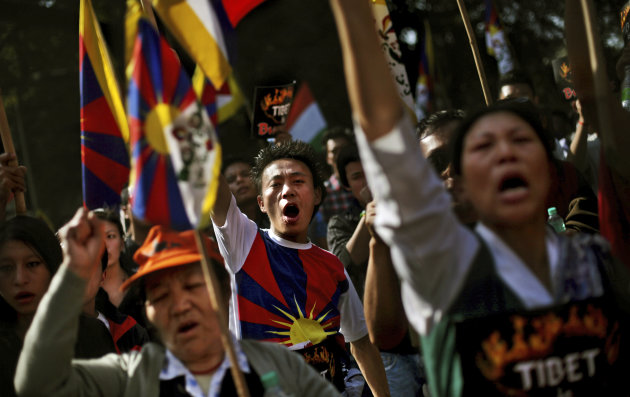


BEIJING (AP) — Two dozen Tibetans have set themselves on fire in western China this month in a dramatic acceleration of the protests against authoritarian Chinese rule, activist groups say.
The surge in self-immolations, along with an increase in large demonstrations, marks a new phase in the Tibetan protests.
At least 86 people have set themselves on fire since the immolations began in 2009. In a change in recent months, most self-immolators now are lay people — some of them acting together — rather than Buddhist monks and nuns who live in tightly monitored monasteries and thus can be more closely watched by authorities.
The protests have also sought to avoid direct attacks on authorities and government property, acts which in the past were used to label them as riots or terrorism, providing an excuse for greater oppression. Despite the altered approach, observers see little short-term possibility of Beijing changing its repressive policies.
"I think the problem will just escalate over time. The government shows no inclination to respond positively to recommendations for reform from the outside or Tibetans," said Michael Davis, a law professor and expert on Tibet at the University of Hong Kong.
In the latest immolation, 24-year-old Kalsang Kyab doused himself with kerosene and set himself alight Tuesday in front of local government offices in Kyangtsa in Aba prefecture, a hotbed of unrest, according to London-based Free Tibet and other groups.
An Aba official said Wednesday he was aware of the immolations but refused to give any details before hanging up.
On Monday, about 1,000 students at a Tsolho Medical Institute staged a bold protest about 900 kilometers (550 miles) to the north in Hainan prefecture in Qinghai province. Riot police fired shots into the air and released tear gas and beat the students with rifle butts, sending 20 students to the hospital, some with serious injuries, Free Tibet reported. Four students were detained as of Tuesday, according to U.S.-funded broadcaster Radio Free Asia.
Tibetan and surrounding ethnically Tibetan regions have been closed off to most outsiders, and firsthand information from the area is extremely difficult to obtain. Authorities have not commented on the protest. Calls to the medical school rang unanswered Wednesday.
Driving the students to protest was a booklet distributed by authorities that derided the Tibetan language as irrelevant, attacked the exiled Tibetan leader the Dalai Lama, and condemned the immolation protests by Tibetans as "acts of stupidity."
The booklet is the latest in a series of perceived slights and intrusive measures by Chinese authorities that have left Tibetans feeling that the culture, language and Buddhist religion that are at the core of their identity are under threat. The feelings have also driven the immolations.
The combination of immolations and large-scale protests is posing a new challenge for security forces, which have been stationed in large numbers in Tibetan areas in recent years.
The surge in self-immolations represents an awareness of the impact they are having among the Tibetan community and internationally, said Robbie Barnett, a Tibet expert at New York's Columbia University. That would likely inspire further protests, increasing the numbers of Tibetans willing to take their lives for the sake of their community, he said.
Most self-immolators have doused themselves with gasoline and set themselves alight after shouting slogans calling for Tibetan independence and blessings for the Dalai Lama, who fled to India in 1959 as Chinese troops — a decade after they occupied the region — were crushing an anti-government uprising.
Though protests have flared periodically over the decades, tensions boiled over in 2008, when deadly rioting broke out in the capital, Lhasa, and sparked an uprising across large swaths of ethnically Tibetan areas. Since then, security — already extremely tight — has been smothering.
The immolations have galvanized many Tibetans, who see them as selfless acts of sacrifice, making it hard for authorities to denounce the immolators. Similarly, protests by students are hard to demonize since they are typically non-violent and centered on issues such as language rights that are guaranteed under the Chinese Constitution.
While local authorities have cracked down hard following the self-immolations and other protests, authorities in Beijing have said relatively little other than to issue routine denunciations of the Dalai Lama and his followers. That indicates they are uncertain how to respond in a way that would bolster their authority and prevent the acts of defiance snow-balling into a full-blown protest movement, Barnett said.
"This suggests that the Tibetans have found a way of at least getting under the skin of the authorities," he said.


